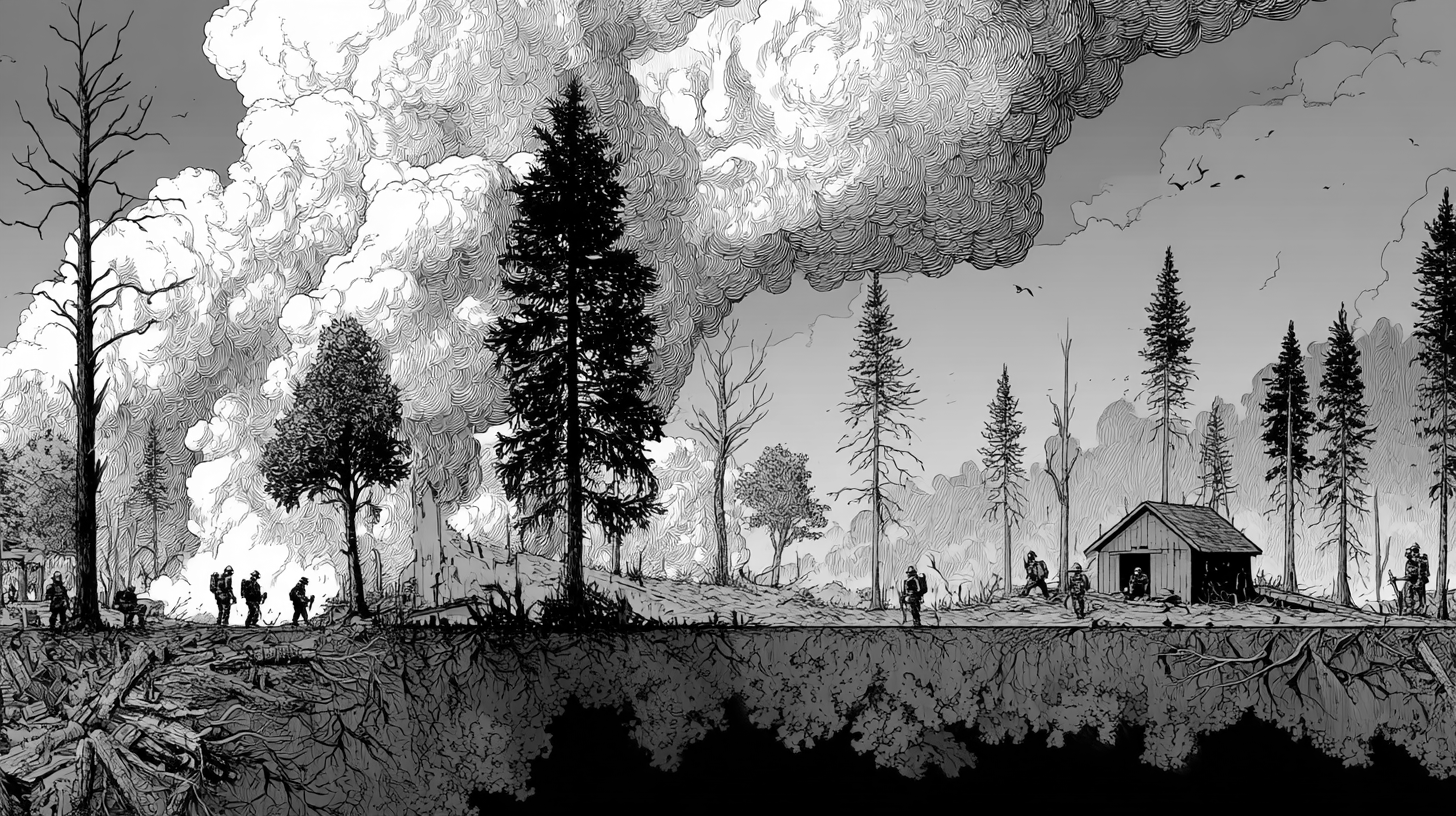
Dion Lim recently wrote a piece comparing the AI cycle to a wildfire rather than a bubble. The distinction matters. Bubbles burst and leave wreckage. Wildfires burn and leave fertile ground.
His taxonomy is sharp: flammable brush (AI wrappers with no moat), fire-retardant giants (the hyperscalers), resprouters (teams that pivot from the ashes), and fire followers (founders who start after the crash). Every previous tech cycle has followed this pattern. The correction comes, capital evaporates, talent redistributes, and what grows next is stronger than what burned.
But there is a fifth category he does not name: the species that runs controlled burns before the wildfire arrives. That is the venture studio.
Studios burn early and on purpose
The defining discipline of a venture studio is killing things. Not after they have consumed years of runway and emotional capital. Early. Before the sunk-cost fallacy sets in.
Most founders face the kill decision once. If they face it at all, the psychological cost is enormous. Walking away from something you have poured yourself into feels like failure. So people delay. They pivot when they should stop. They raise another round to buy time rather than face the signal.
A studio inverts this. Killing a venture that is not working is the system functioning correctly. It is a controlled burn: clearing the brush before it accumulates into something dangerous. The resources get freed. The lessons get absorbed. The next venture starts from a higher baseline.
This is why the studio model is structurally fire-resistant. By the time the market correction arrives, a well-run studio has already burned through its own bad ideas. What remains is what survived the internal selection pressure.
Lean teams do not need the oxygen of abundant capital
Lim's article describes the current AI ecosystem as an overgrown forest: too many startups competing for the same talent, the same capital, the same customers. When everyone's roots are tangled, fire is inevitable.
Studios operate differently. A small, senior team running AI agents across the venture lifecycle does not need 50 engineers to test a hypothesis. It does not need a $10M seed round to reach its first customer. The cost of iteration is low enough that a correction in capital markets is an inconvenience, not an existential threat.
When the fire comes and capital tightens, the companies that need abundant funding to survive will ignite first. The companies that were already running lean, by design and not by necessity, will barely feel the heat.
This is not austerity. It is architecture. Small crews with high leverage have less surface area for fire to catch.
Post-fire conditions are studio conditions
Every tech cycle tells the same story after the burn: talent becomes available, infrastructure gets cheaper, noise drops, and the founders who start building in the ashes have structural advantages over those who started in the boom.
LinkedIn launched in 2002. Stripe in 2010. Slack in 2013. All fire followers. All built on the infrastructure and talent that the previous cycle overbuilt and then released.
The AI correction will follow the same pattern. Compute costs will fall. Engineers from failed AI wrappers will be looking for real problems to solve. The hype-driven competition will thin out, leaving clearer signal for companies solving genuine problems.
These are ideal conditions for a venture studio. Cheaper to build. Easier to hire. Less noise in the market. The studio's job (finding signal, validating fast, committing fully to what works) gets easier in every dimension.
The real test: conviction under scarcity
Lim asks the right question: can you sustain your business model when external capital disappears?
For a studio, the answer depends on whether you have found something real before the fire arrives. If you are still searching, still running controlled burns, still validating hypotheses, scarcity just means the experiments are cheaper. You keep going.
If you have found it, if the signal is clear, the customer is paying, the problem is real, then the fire is your accelerator. Competitors who were burning cash to keep up are gone. Talent that was locked up in overfunded startups becomes available. The market gets quieter, and the customers who remain are the ones who actually need what you are building.
This is the moment to go all in. Not with reckless spending, but with focused, total commitment to the venture that survived your own selection pressure.
What we are doing about it
At [r]think, we have already run our controlled burns. We have tested hypotheses, killed what did not work, and committed fully to what did.
deetech is where our conviction landed. AI forensic media verification for insurance: a problem that is real, growing, and structurally underserved. We are not hedging. We are not running ten things at once. We found the signal, and we are pouring everything into it.
The fire can come. We are not flammable brush waiting to ignite. We are not a fire-retardant giant with deep reserves and no urgency. We are the team that already burned through the bad ideas, found the right problem, and committed with everything we have.
The companies that survive the wildfire are not the ones with the most capital. They are the ones with the deepest conviction in a problem worth solving.
When the smoke clears, the question will not be who had the most funding. It will be who built something that customers need regardless of market conditions. That is what fire-resistance actually looks like.
The wildfire is coming. We built for it.